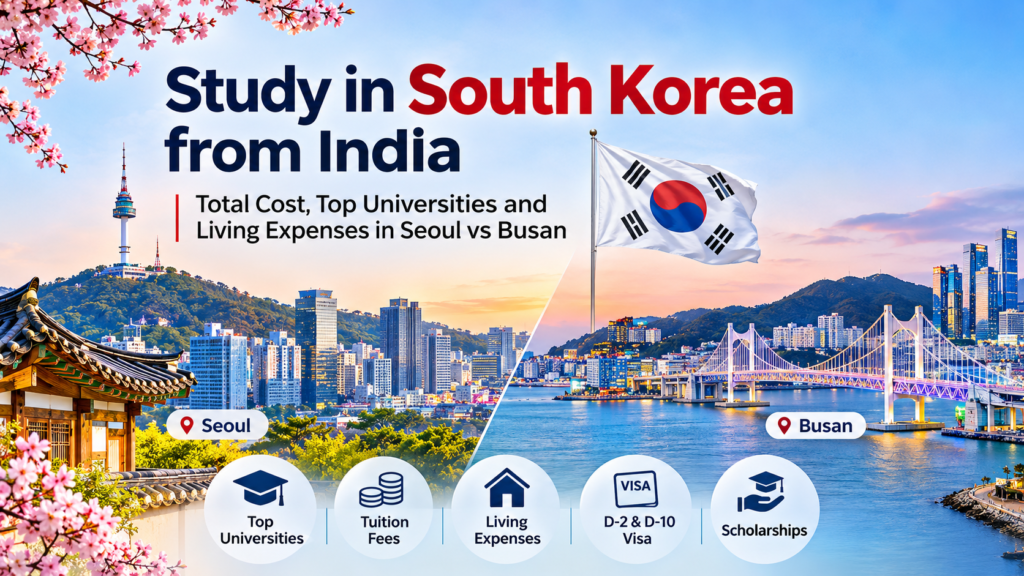
South Korea has moved from a niche option to a serious choice for Indian students. It combines globally ranked universities, a strong technology and manufacturing economy, many English-taught programmes and a fully funded government scholarship. If you want to study in South Korea from India, the biggest practical question is cost, and specifically how much your city choice changes it. This guide compares Seoul and Busan in rupees.
Why Study in South Korea?
Korea is home to leading research universities and companies in electronics, automotive, semiconductors, biotechnology and entertainment. Tuition at public universities is modest compared with the UK, USA or Australia, and the D-10 job-seeker visa lets eligible graduates stay on to look for work. Many degree programmes are taught in English, though basic Korean, usually measured by the TOPIK test, helps in daily life and in the job market.
Top Universities in South Korea for Indian Students
- Seoul: Seoul National University, Yonsei University, Korea University and Hanyang University.
- Daejeon: KAIST, known for engineering, science and technology.
- Pohang: POSTECH, strong in research-driven science and engineering.
- Busan: Pusan National University and other regional universities with lower living costs.
Admission competitiveness varies. Top universities expect strong marks, English scores and a clear statement of purpose, while others are more accessible. Reports in 2026 indicated that South Korean authorities restricted visa issuance for a number of institutions, so always confirm that your chosen university is currently eligible to sponsor international student visas.
Tuition Fees in South Korea
Fees vary by university and subject, so the following are indicative planning ranges at ₩1,000 = ₹67:
University type | Tuition per year (approx.) | In rupees (approx.) |
Public university | ₩4 million to ₩8 million | ₹2.68 lakh to ₹5.36 lakh |
Private university | ₩8 million to ₩16 million | ₹5.36 lakh to ₹10.72 lakh |
Engineering, medicine and arts courses usually sit at the top of each range. Scholarships, including the Korean Government Scholarship Program (GKS) and university merit awards, can reduce or cover tuition for strong candidates.
Living Expenses: Seoul vs Busan
Monthly item | Seoul | Busan |
Rent (one-room or goshiwon) | ₩5,00,000 (₹33,500) | ₩3,50,000 (₹23,450) |
Food | ₩3,50,000 (₹23,450) | ₩3,00,000 (₹20,100) |
Transport | ₩60,000 (₹4,020) | ₩50,000 (₹3,350) |
Phone and internet | ₩40,000 (₹2,680) | ₩40,000 (₹2,680) |
National health insurance | ₩70,000 (₹4,690) | ₩70,000 (₹4,690) |
Personal spending | ₩1,50,000 (₹10,050) | ₩1,20,000 (₹8,040) |
Total per month | ₩11,70,000 (₹78,390) | ₩9,30,000 (₹62,310) |
Over twelve months, living in Seoul costs about ₹9,40,680 against ₹7,47,720 in Busan, a saving of roughly ₹1.93 lakh a year. Many students reduce this further through university dormitories. Remember that refundable housing deposits, known as key money, can run into millions of won in private rentals, so ask about dormitory availability early.
Total First-Year Cost: A Worked Example
Assume a public university with tuition of ₩6 million, which is ₹4.02 lakh. Add living costs and the first-year total is about ₹13.43 lakh in Seoul or ₹11.50 lakh in Busan, before flights, visa fees and one-time setup costs. These are sample figures and exchange rates change, so refresh them before planning your loan or savings.
D-2 Visa, Work Rights and the D-10 Route
- D-2 student visa: You apply with your admission certificate and financial proof, commonly about ₩20 million in a recent bank statement, though requirements vary by university and city.
- Part-time work: Students can usually work up to about 20 hours a week after an initial period, subject to permission and Korean language rules.
- D-10 job-seeker visa: Graduates can stay for up to around two years in total to find a job, usually granted in shorter blocks.
- Health insurance: National health insurance enrolment is mandatory for students.
Immigration rules can change, so verify details with your university and the Korean embassy before relying on them.
Seoul or Busan: Which Should You Choose?
Seoul offers the highest concentration of top universities, internships and corporate recruiters, but rent and daily costs are higher. Busan is a major port city with a relaxed pace, beaches and noticeably lower living costs, and Pusan National University is well regarded for engineering and science. If your course is research focused or you want to be near head offices of large companies, Seoul can justify the extra spend. If budget is your priority, Busan or another regional city can save nearly two lakh rupees a year.
English Tests and Korean Language Preparation
English-taught degrees usually ask for IELTS or TOEFL scores, while Korean-taught degrees require a TOPIK level, often TOPIK 3 or higher. Indian students commonly need six to twelve months to reach that level from scratch, so plan your timeline accordingly. Starting English test preparation early also keeps scholarship options open.
How EdMaster Helps Vadodara Students Study in South Korea
EdMaster supports students from Vadodara and across Gujarat with South Korea admissions, funds planning and visa filing. We help you compare Seoul with regional cities, shortlist universities through profile assessment, prepare your SOP and documents, and plan your visa and post-departure steps. If your programme needs an English score, our IELTS coaching in Vadodara prepares you with mock tests and personalised feedback.
Choosing among Overseas Education Consultants in Vadodara for Asia?
See our Study in South Korea page or speak to a counsellor for a free session.
Ready to Take the Next Step?
Book a free consultation with EdMaster and get a profile-based plan for your country, course, budget and visa. EdMaster Study Abroad Consultants, 102 Atlantis Heights, Dr Vikram Sarabhai Marg, near Genda Circle, Subhanpura, Vadodara, Gujarat 390023. Call +91 72269 33337, WhatsApp +91 72269 33336, email hello@edmaster.co. Open Monday to Saturday, 10:00 am to 7:30 pm.
Frequently Asked Questions:
As a planning figure, first-year costs at a public university are roughly ₹11.5 lakh to ₹13.5 lakh including tuition and living costs, depending on whether you live in Busan or Seoul. Private universities cost more.
Yes. On our sample budgets Busan costs about ₹62,310 a month against ₹78,390 in Seoul, mostly because of lower rent and food costs.
Not for English-taught programmes, but basic Korean is very helpful. Korean-taught degrees usually require a TOPIK score, and many students take a language programme first.
Graduates can apply for the D-10 job-seeker visa to stay for up to around two years while looking for work, and then move to a work visa if they find a suitable job.
Yes. The Korean Government Scholarship Program (GKS) and many university merit scholarships support international students. They are competitive and have fixed deadlines, so apply early.