
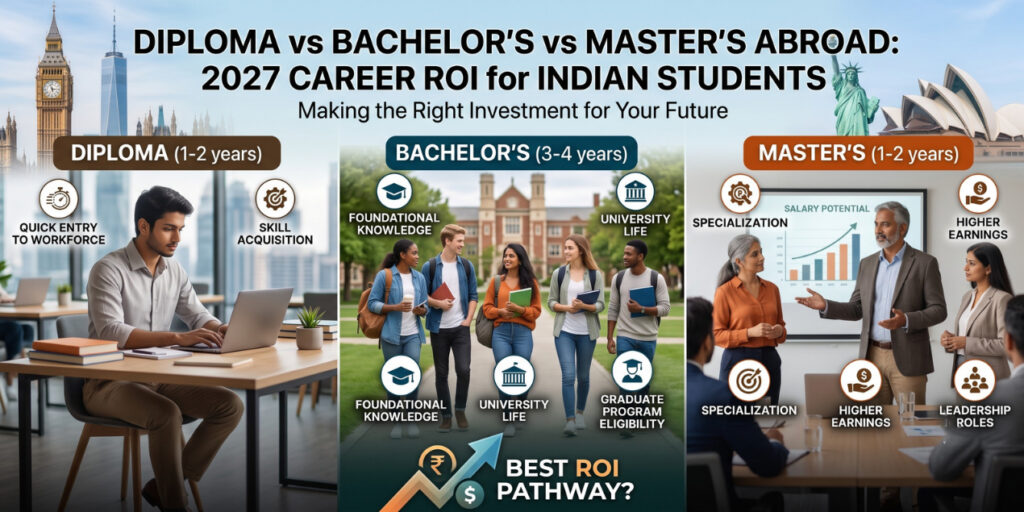
Not every strong career abroad starts with a master’s degree — and not every student needs a full bachelor’s either. Diplomas, postgraduate diplomas, bachelor’s and master’s programmes each solve a different problem, cost a different amount, and lead to different career timelines. Here’s how to actually compare them for a 2027 application, instead of defaulting to whichever one sounds most prestigious.
What Each Path Actually Is
- Diploma / Postgraduate Diploma: A focused, often 1-2 year programme, usually skills- and industry-aligned, popular in Canada and Australia as a faster, lower-cost entry point
- Bachelor’s Degree: A 3-4 year foundational degree, typically for students straight out of Class 12, building broad subject knowledge before specialisation
- Master’s Degree: A 1-2 year advanced, specialised degree, usually for students who already have a bachelor’s and want deeper expertise or a career pivot
Cost and Duration at a Glance
Path | Typical Duration | Typical Total Cost (INR) | Entry Requirement |
PG Diploma | 1 – 2 years | Rs 15 – 35 lakh | Bachelor’s degree |
Bachelor’s | 3 – 4 years | Rs 40 lakh – 1.2 crore | Class 12 |
Master’s | 1 – 2 years | Rs 25 – 90 lakh | Bachelor’s degree |
A postgraduate diploma is almost always the lowest upfront cost and shortest timeline of the three, which is exactly why it has become popular in Canada and Australia as a pathway rather than a standalone career move.
Career ROI: What the Numbers Actually Show
ROI on a foreign qualification depends on three things working together: total cost, realistic starting salary in your target country, and how long your post-study work visa gives you to land that salary. A general starting-salary comparison for STEM master’s graduates looks roughly like this across major destinations.
Field | USA | UK | Germany |
Computer Science / STEM MS | $88,000 – $115,000 | £35,000 – £55,000 | €52,000 – €70,000 |
Business / Management | $70,000 – $90,000 | £35,000 – £55,000 | €45,000 – €60,000 |
A simple break-even formula many counsellors use: divide your total investment by your expected annual savings (salary minus living costs) to estimate the number of years to recover your cost. As a general benchmark, a programme that breaks even within three to five years of graduation is considered a strong financial decision.
When a Diploma Makes the Most Sense
- You want the fastest, lowest-cost route into a country with strong post-study work-to-PR pathways, especially Canada
- You already have a bachelor’s degree and want a practical, industry-specific skill set rather than another full degree
- You’re prioritising speed to a work permit over depth of specialisation
In Canada specifically, a PG diploma from a recognised institution can lead directly into a Post-Graduation Work Permit (PGWP) and, from there, into Express Entry for permanent residency — making it a genuinely strategic, not just budget, choice for many students.
When a Bachelor’s Degree Makes the Most Sense
- You’re a Class 12 graduate who wants broad exposure before committing to a specialisation
- Your target career (medicine, law, architecture) structurally requires a full undergraduate degree abroad
- You want the longest possible runway to build local networks, internships and language skills before entering the job market
When a Master’s Degree Makes the Most Sense
- You already have a bachelor’s and want to move into a higher-paying, more specialised role
- Your target field (data science, engineering, finance) shows a clear, structural salary premium for a master’s-qualified candidate
- You’re using the degree deliberately as an immigration and career pivot, not just credentialing
Fields like computer science, data engineering, healthcare and semiconductor engineering currently show some of the fastest break-even periods among master’s programmes, largely because starting salaries in those fields have kept pace with rising tuition, unlike some humanities and generalist management programmes.
The Honest Trade-Off
A diploma gets you working sooner but caps your salary ceiling lower than a master’s in most fields. A master’s costs more and takes longer but generally unlocks a meaningfully higher salary band and more senior roles over a 5-10 year career horizon. A bachelor’s is rarely a ‘faster ROI’ choice — it’s a foundational investment that pays off over a longer career arc, not an immediate one. There’s no universally correct answer; the right path depends on your existing qualifications, target country, target field and how much runway your family’s budget genuinely allows.
How EdMaster Helps You Choose the Right Path
This decision shouldn’t be made by comparing brochures — it should come out of an honest profile assessment: your current qualifications, budget, target country and career goals. EdMaster’s counsellors in Vadodara run exactly this assessment for every student, comparing diploma, bachelor’s and master’s routes side by side against realistic cost and salary data, before recommending university and course shortlists, so you’re choosing a path with a clear financial and career logic, not just a familiar label.
Not sure whether a diploma, bachelor’s or master’s is the right move for your goals and budget? Book a free profile assessment with EdMaster in Vadodara.
Frequently Asked Questions:
Not in fields where it's an established pathway, like Canada's PG diploma-to-PGWP-to-PR route — employers and immigration systems there treat it as a legitimate, strategic qualification, not a lesser one.
Generally yes, provided the diploma meets the credit and academic requirements of your target master's programme — this varies by university and should be confirmed individually.
PG diplomas typically break even fastest due to lower upfront cost, but master's degrees in high-demand fields like data engineering often catch up quickly due to significantly higher starting salaries.