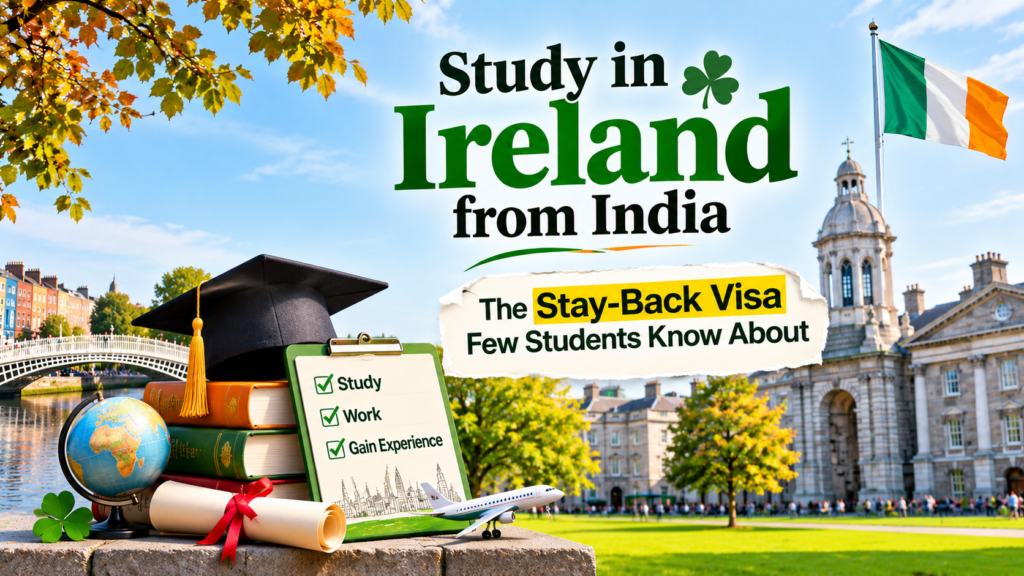
Ask most families in Vadodara which countries let you work after studying, and the answers are usually Canada, the UK and Australia. Ireland rarely makes the list, and that is a missed opportunity. Ireland runs one of the most generous post-study work schemes in Europe, and it does not depend on a job offer, an employer sponsor or a salary threshold. If you are thinking about how to study in Ireland from India, understanding this single permission can change how you compare countries.
What Is the Ireland Stay-Back Visa (Stamp 1G)?
The stay-back visa is officially called the Third Level Graduate Programme, and the permission you receive is stamped as Stamp 1G in your Irish Residence Permit. It lets eligible non-EU graduates remain in Ireland after their course ends and look for graduate-level work. During this period you can work full time, up to 40 hours a week, without needing an employment permit. Compare that with the 20-hour weekly limit that applies to students during term time.
How long you can stay depends on the level of your degree on the Irish National Framework of Qualifications:
Qualification | NFQ level | Stamp 1G duration | Work hours |
Honours Bachelor’s degree | Level 8 | 12 months | Up to 40 hours a week |
Master’s degree | Level 9 | Up to 24 months (12 + 12) | Up to 40 hours a week |
PhD / Doctorate | Level 10 | Up to 24 months (12 + 12) | Up to 40 hours a week |
Master’s and PhD graduates are first granted 12 months and can extend by a further 12 months, provided they show genuine efforts to find graduate-level employment. Rules are updated by the Irish immigration authorities from time to time, so always confirm the latest position with your university’s international office before you plan around it.
Why Most Indian Students Miss This Advantage
- No job offer needed. You apply based on your Irish qualification, not on an employer’s sponsorship.
- Full-time work rights. Graduates can take any suitable role, internship or contract during the search period.
- A bridge to longer-term residence. The permission gives time to secure a job that qualifies for a Critical Skills Employment Permit, which can lead towards longer-term residence. Salary thresholds for these permits are revised periodically, so check current figures.
- Less competition for attention. Ireland is marketed far less aggressively than larger destinations, so students often discover Stamp 1G only after shortlisting other countries.
Who Qualifies for the Irish Stay-Back Visa?
Eligibility is straightforward, but the details matter. In general you need to be a non-EU/EEA national who has completed a qualification at Level 8 or above from a recognised Irish institution, held a valid student permission (Stamp 2) throughout, and applied within the window after your results are confirmed. Current guidance describes this window as roughly six months from notification of your award, so do not wait until the last week. Keep your attendance and Stamp 2 records in order from the first semester because immigration officers can ask for them.
Why Ireland Works for Indian Students
Ireland is English speaking, compact and well connected to the technology, pharmaceutical, medical devices and financial services sectors. Dublin, Cork, Limerick and Galway host European headquarters or major offices of global companies, which is why courses in data analytics, computing, biotechnology, pharma and business are popular with Indian applicants. Most Master’s programmes ask for an IELTS score of around 6.0 to 6.5 overall, though requirements vary by university and course.
What Does It Cost? A Realistic Budget
Tuition for non-EU students typically falls between €12,000 and €25,000 a year for most programmes, and is higher for medicine and some MBAs. For the student visa you generally need to show access to about €10,000 in living funds in addition to tuition, though you should verify the current figure. A sample monthly living budget outside central Dublin is roughly €1,250, which is about ₹1.37 lakh at €1 = ₹110. Cork and Limerick tend to be cheaper than Dublin, mainly because of rent.
Your Step-by-Step Plan for 2027 Intakes
- 12 months before: Shortlist courses and universities based on your profile, budget and career goal.
- 9 to 10 months before: Book your English test (IELTS, PTE, TOEFL or Duolingo, depending on the university) and start drafting your SOP.
- 6 to 8 months before: Submit applications, track offers and compare scholarships.
- 3 to 4 months before: Pay the deposit, arrange funds or an education loan, and prepare visa documents.
- After arrival: Register with immigration, maintain attendance and begin career-centre networking in your first semester.
- In your final term: Prepare your Stamp 1G application and keep your documents ready for the day results are released.
How EdMaster Helps Vadodara Students Study in Ireland
EdMaster is a study abroad consultancy in Subhanpura, Vadodara, with dedicated guidance for Ireland. Our counsellors begin with a psychometric test and a one-to-one conversation so your course choice matches your strengths, not just a trend. From there we handle profile assessment and university shortlisting, SOP support, application follow-ups and visa guidance with post-departure assistance. We also help families compare education loan options and prepare for English tests through our IELTS coaching in Vadodara.
Looking for Ireland Student Visa Consultants in Vadodara who will explain stay-back rules clearly before you commit? Explore ourStudy in Ireland page or book a free consultation.
Ready to Take the Next Step?
Book a free consultation with EdMaster and get a profile-based plan for your country, course, budget and visa. EdMaster Study Abroad Consultants, 102 Atlantis Heights, Dr Vikram Sarabhai Marg, near Genda Circle, Subhanpura, Vadodara, Gujarat 390023. Call +91 72269 33337, WhatsApp +91 72269 33336, email hello@edmaster.co. Open Monday to Saturday, 10:00 am to 7:30 pm.
Frequently Asked Questions:
Under the Third Level Graduate Programme, Level 8 graduates can stay for 12 months and Master’s or PhD graduates (Levels 9 and 10) for up to 24 months, usually granted as two 12-month blocks.
No. You apply on the basis of your Irish qualification and your Stamp 2 student permission. A job offer is not required at the application stage.
Yes. Stamp 1G holders can generally work up to 40 hours a week without an employment permit, compared with the 20-hour limit for students in term time.
Most universities ask for an English proficiency score, commonly IELTS 6.0 to 6.5 for Master’s courses, and many also accept PTE, TOEFL or Duolingo. Some waive the test for eligible applicants, so confirm per university.
Choose a consultant who offers profile-based shortlisting, written cost estimates and visa support rather than guarantees. EdMaster offers free initial counselling at its Subhanpura office and online.