

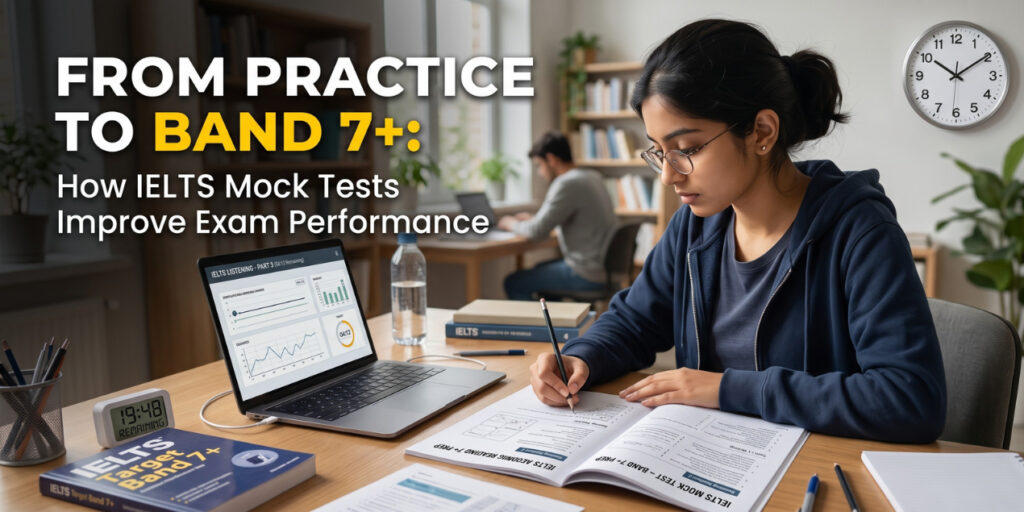
Every year, thousands of students across Vadodara sit for the IELTS exam aiming for a Band 7 or higher, the score that unlocks admission and scholarship eligibility at most top universities abroad. Yet many capable students, fluent in English and academically strong, fall short simply because they never practised under real exam conditions. This is where mock tests make the difference between knowing English and performing under a strict, timed exam. Here is exactly how structured mock testing takes a student from inconsistent practice to a confident Band 7+.
Why Band 7+ Matters for Study Abroad
A Band 7 overall is often the threshold for admission into competitive master’s programmes, scholarship consideration, and even certain visa categories in countries like Canada and Australia. Scoring below this mark, even by half a band, can shut the door on your preferred university or force you into a foundation English course that costs extra time and money. This makes every mark in every section count.
Why Real Practice Beats Passive Studying
Reading grammar rules and watching YouTube tutorials builds knowledge, but IELTS is a performance exam with a strict clock. Students who only study passively often know the right answer but run out of time, misread a question under pressure, or freeze during the Speaking test. Mock tests close this gap by training your brain to work accurately within real exam constraints, not just in theory.
How Mock Tests Improve Each IELTS Section
- Listening: Repeated mock exposure trains your ear to catch answers the first time, since the recording never repeats in the real exam
- Reading: Timed mock passages build the skimming and scanning speed needed to finish all three passages within 60 minutes
- Writing: Practising full Task 1 and Task 2 essays under a 20-and-40-minute split teaches you to plan, write and review without rushing the conclusion
- Speaking: Simulated interview mocks reduce hesitation and build the fluency examiners look for in a real face-to-face or computer-based test
The Science of Mock Testing: Timing, Accuracy and Stamina
IELTS is a 2 hour 45 minute exam that demands sustained concentration. Attempting full-length mock tests, not just section-wise drills, builds the mental stamina needed to stay sharp through the final Reading passage or the closing minutes of Writing Task 2. Reviewing every mock test afterwards — identifying which question types you consistently lose marks on — turns each attempt into a targeted improvement plan rather than just repeated practice.
Common Mistakes Students Make Without Mock Practice
- Underestimating time pressure and running out of time in Reading or Writing
- Never receiving structured feedback on Speaking, so the same errors repeat in the real test
- Practising only easy or familiar question types and avoiding weak areas
- Walking into the real exam without ever having completed a full-length test in one sitting
EdMaster’s Mock Test Approach in Vadodara
At EdMaster, IELTS preparation is built around weekly full-length mock tests conducted under real exam conditions, followed by one-on-one feedback sessions with certified trainers. Every mock Speaking test is recorded and reviewed for fluency, pronunciation and coherence, while Writing mocks are scored against the official IELTS band descriptors so students know exactly where they stand. This structured, data-driven mock testing system is why EdMaster students in Vadodara consistently move from inconsistent scores to a confident Band 7 and above.
A Sample 4-Week Mock Test Plan
Week | Focus |
Week 1 | Diagnostic full mock test to identify current band and weak sections |
Week 2 | Section-wise timed drills targeting weak areas, plus one full mock |
Week 3 | Two full-length mock tests with detailed Writing and Speaking feedback |
Week 4 | Final full mock under exact exam-day conditions, plus revision of error patterns |
Frequently Asked Questions:
Most successful candidates complete at least 4 to 6 full-length mock tests, alongside regular section-wise practice, in the four weeks leading up to their exam.
Yes. Mock tests build accuracy, timing and exam-day stamina, and structured feedback helps you correct recurring mistakes before they cost you marks in the real test.
Speaking and Writing typically see the biggest gains, since both sections benefit most from expert feedback that self-study alone cannot provide.
Yes, always. Practising without strict timing builds a false sense of readiness that often collapses under real exam pressure.
Yes, every EdMaster mock test is followed by detailed feedback from certified IELTS trainers, covering band-wise performance across all four sections.