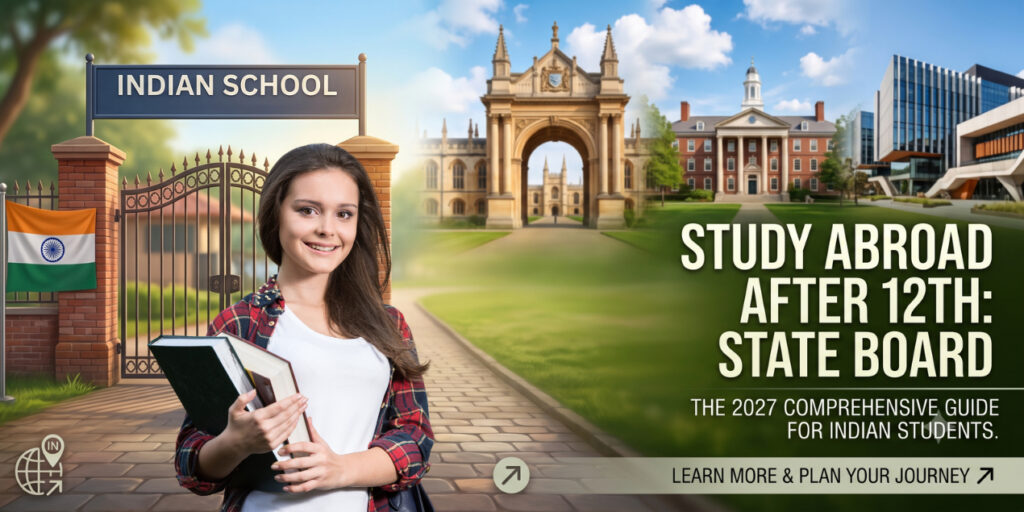
Every year, hundreds of students from Vadodara who have completed their 12th grade through the Gujarat State Board or another state board wonder whether they can study abroad straight after school, or whether a CBSE or ICSE background is required. The good news is that state board students are fully eligible to study abroad, provided they understand a few extra steps most universities expect. This 2027 guide walks you through eligibility, foundation pathways and the best countries for state board students heading abroad after 12th.
Can State Board Students Study Abroad After 12th?
Absolutely. Universities abroad evaluate your marksheet, subject combination and overall percentage, not which board issued it. State board students from Gujarat, Maharashtra, and other states are admitted every year into top universities across the USA, UK, Canada, Australia and Europe. What matters is meeting each university’s minimum academic percentage, subject prerequisites, and English proficiency requirement.
Common Challenges for GSEB and State Board Students
- Grading scale differences — some universities require a percentage-to-GPA conversion that state boards don’t provide directly
- Limited exposure to English-medium instruction, making a strong IELTS or PTE score essential
- Fewer extracurricular or research opportunities documented on report cards, which some competitive universities weigh heavily
- Uncertainty about whether a 12-year, state-board schooling system meets a country’s minimum “13 years of education” entry requirement
Foundation and Pathway Programs – The Bridge You Need
Some countries, particularly the UK and Australia, expect 13 years of formal schooling before direct entry into a bachelor’s degree. Since the Indian 10+2 system covers 12 years, many state board students bridge the gap with a one-year Foundation Programme at a university-affiliated college. It also builds academic English and study skills before the degree begins.
In the UK, a foundation or pathway programme is also the route for students whose 12th-grade percentage falls short of a university’s direct entry requirements. Rather than losing the chance to study there, they can strengthen their profile and progress into the degree.
Most programmes run for about one academic year (some intensive options are shorter). Students who meet the required grades at the end usually progress straight into the first year of the bachelor’s degree at the partner university, so no fresh application is needed.
The USA and Canada, by contrast, generally accept Indian 12th-grade students directly into bachelor’s programmes without a foundation year.
English Proficiency Requirements
Since most state boards teach many subjects in Gujarati or regional language mediums, English proficiency tests carry extra weight in your application. IELTS, TOEFL, PTE Academic or Duolingo English Test scores are used to prove you can handle coursework in English. Most undergraduate programmes look for an IELTS band of 6.0 to 6.5 overall, though competitive universities and foundation-year waivers can require higher or allow slightly lower scores with supporting coursework.
Best Countries for State Board Students After 12th
Country | Entry Route | Typical IELTS Requirement |
USA | Direct Bachelor’s admission | 6.0 – 6.5 |
Canada | Direct Bachelor’s admission | 6.0 – 6.5 |
UK | Foundation Year, then Bachelor’s | 5.5 – 6.5 |
Australia | Foundation Year, then Bachelor’s | 5.5 – 6.5 |
Germany | Studienkolleg (Foundation), then Bachelor’s | 5.5 – 6.0 plus German basics |
Direct Bachelor’s Admission vs Foundation Year – Which Is Better?
If your target country accepts direct entry, such as the USA or Canada, and your academic percentage and English score meet the requirement, direct entry saves you a full year of time and fees. If your target country mandates a foundation year, such as the UK or Australia for some universities, treat it as a genuine advantage rather than a delay — it eases the academic and cultural transition and often guarantees progression into the linked bachelor’s degree.
Documents Required
- 12th grade marksheet and school leaving certificate
- Passport and passport-size photographs
- IELTS/TOEFL/PTE score report
- Statement of Purpose (SOP)
- Letters of recommendation from school teachers
- Proof of funds or education loan sanction letter
How EdMaster Guides Vadodara Students From Day One
EdMaster specialises in guiding state board students from Vadodara and across Gujarat through exactly this journey — from percentage-to-GPA conversion and foundation programme selection, to English test coaching and country-specific document checklists. Because our counselors work closely with GSEB and other state board students every admission cycle, EdMaster knows precisely which universities offer the smoothest, most affordable path from 12th grade to a global degree.
Frequently Asked Questions:
Yes. The USA and Canada generally accept Indian state board students directly into bachelor's programmes, provided academic and English proficiency requirements are met.
Countries like the UK and Australia expect 13 years of schooling before a bachelor's degree. Since the Indian 10+2 system completes 12 years, a one-year foundation programme bridges that gap. In the UK, it is also the route for students whose 12th-grade percentage falls short of direct entry requirements.
Most undergraduate programmes require an IELTS band of 6.0 to 6.5 overall, though this varies by university and course.
No. Universities evaluate your marks, subjects and English proficiency, not the board name. A well-prepared state board applicant is treated the same as any other applicant.
Yes, EdMaster guides students through both routes and helps identify which path — direct entry or foundation year — best suits their profile, budget and target country.