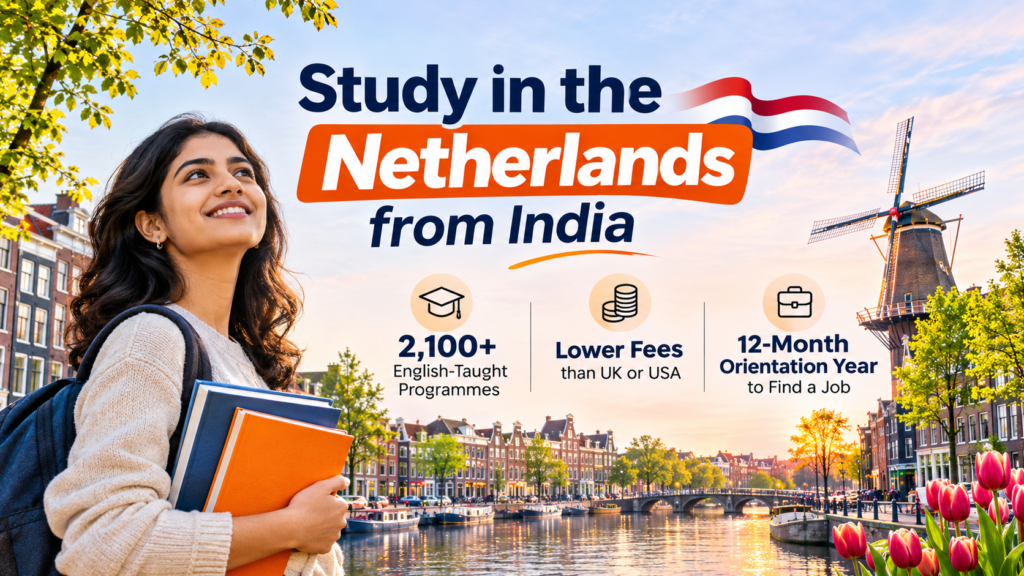
The Netherlands is one of the most practical choices for Indian students who want a European degree without leaving everything to chance. It offers more than 2,100 English-taught programmes, fees that are often lower than comparable courses in the UK or USA, and a 12-month Orientation Year that gives graduates time to find a job. If you are researching how to study in the Netherlands from India, here is what the numbers and rules actually look like.
Why the Netherlands Appeals to Indian Students
Dutch universities teach in English across engineering, business, data science, life sciences, design and social sciences. Teaching is interactive and project based, and most people in the country speak fluent English, so daily life is manageable without Dutch. The country also sits in the Schengen area, which makes travel across Europe easy during your degree.
A word on the phrase low fees. The Netherlands is not free. EU and EEA students pay a flat statutory fee of about €2,694 for 2026/27, but Indian students pay higher institutional fees. They are still competitive: lower than many UK and US options, and several universities of applied sciences sit well below research universities.
Tuition Fees for Indian Students
Type of institution | Typical non-EU tuition per year | In rupees (€1 = ₹110) |
Universities of applied sciences (HBO) | About €8,300 to €9,500 | About ₹9.1 to ₹10.5 lakh |
Research universities, Bachelor’s | About €13,000 to €22,000 | About ₹14.3 to ₹24.2 lakh |
Research universities, Master’s | About €15,000 to €25,000 | About ₹16.5 to ₹27.5 lakh |
Engineering and business programmes sit at the top of these ranges, and fees have been rising year on year, with further increases expected for 2027/28. Applying early and locking in your intake helps. Scholarships such as the Holland Scholarship and university excellence awards at institutions like Utrecht and TU Delft can reduce the bill, but amounts, eligibility and deadlines change each year.
Living Costs and Proof of Funds
Outside Amsterdam, a student can expect to spend roughly €750 to €950 a month. Our sample budget is €920, or about ₹1,01,200 a month. For the residence permit, non-EU students must show a minimum monthly amount set by the Dutch immigration service, which was about €1,130 per month for 2026 and is updated each year. As a worked example, tuition of €15,000 (₹16.5 lakh) plus living costs of €11,040 (₹12.14 lakh) gives roughly ₹28.64 lakh for the first year.
The Orientation Year: Your Post-Study Job Window
The Orientation Year, often called the zoekjaar, is a 12-month residence permit for graduates of recognised Dutch institutions, and graduates must apply within three years of finishing their degree. During this year you can take any job, freelance or start a business, and there is no salary threshold. If you find a qualifying job, you can move to the Highly Skilled Migrant permit, which has a lower salary requirement for recent graduates. After a period of continuous residence, longer-term residence becomes possible, though language and integration requirements apply. Confirm current rules on the IND website before relying on any timeline.
Admission Requirements and Deadlines
- Academics: Indian degrees are evaluated against Dutch standards, and some universities ask for a credential evaluation.
- English test: IELTS and TOEFL are widely accepted, and some programmes accept Duolingo. Master’s courses often ask for around IELTS 6.5, but it varies.
- Application route: Most applications go through Studielink and the university portal.
- Deadlines: Popular and limited-seat programmes can close as early as 15 January, standard programmes around 1 May, and many universities set earlier dates for non-EU students.
- Intake: September is the main intake, with a few programmes starting in February.
Which Test Should You Take?
Do not pick a test before you pick a programme. Check which tests each university accepts, then match your strengths. Students who are comfortable with a computer-adaptive format often prefer Duolingo where accepted, while those aiming for competitive programmes usually choose IELTS or TOEFL.
Popular Universities and Courses
Well-known Dutch choices include TU Delft, the University of Amsterdam, Utrecht University, Leiden University, Erasmus University Rotterdam, the University of Groningen, Maastricht University, the University of Twente, Eindhoven University of Technology and Wageningen University. Popular courses for Indian students include engineering, data science, artificial intelligence, business and finance, agri-food and life sciences. Shortlist across ambitious, realistic and safe options, since selection rates differ sharply between institutions.
Common Mistakes to Avoid
The most common errors are missing early programme deadlines, ignoring housing until after the offer, and assuming every English-taught course accepts every English test. Housing in Dutch student cities is tight, so start searching as soon as you have an admission.
How EdMaster Helps Vadodara Students Study in the Netherlands
EdMaster, a study abroad consultancy in Subhanpura, Vadodara, guides students from course selection to visa filing for the Netherlands. We start with profile assessment and shortlisting, help with Studielink applications and SOP writing, and support your visa and post-departure planning. Our language team runs TOEFL coaching in Vadodara, Duolingo English Test coaching and IELTS coaching, so you can prepare for the test your target universities actually accept.
Comparing Overseas Education Consultants in Vadodara for Europe?
Visit our Study in Netherlands page or book a free consultation to see which Dutch universities match your profile and budget.
Frequently Asked Questions:
It is cheaper than the UK or USA for many courses but not free. Non-EU tuition typically ranges from about €8,000 to €25,000 a year, plus roughly €750 to €950 a month for living outside Amsterdam.
It is a 12-month residence permit for non-EU graduates of Dutch institutions to find work, with no salary threshold and the freedom to take any job. You must apply within three years of graduating.
Some programmes accept TOEFL or Duolingo, and a few waive English tests for eligible applicants. Requirements differ by university, so check each programme.
Not to study in an English-taught programme. Dutch becomes useful for daily life and many jobs, and it is required for long-term residence and citizenship.
Start 8 to 12 months ahead. Some programme deadlines fall in January, and scholarship and housing searches take time.