
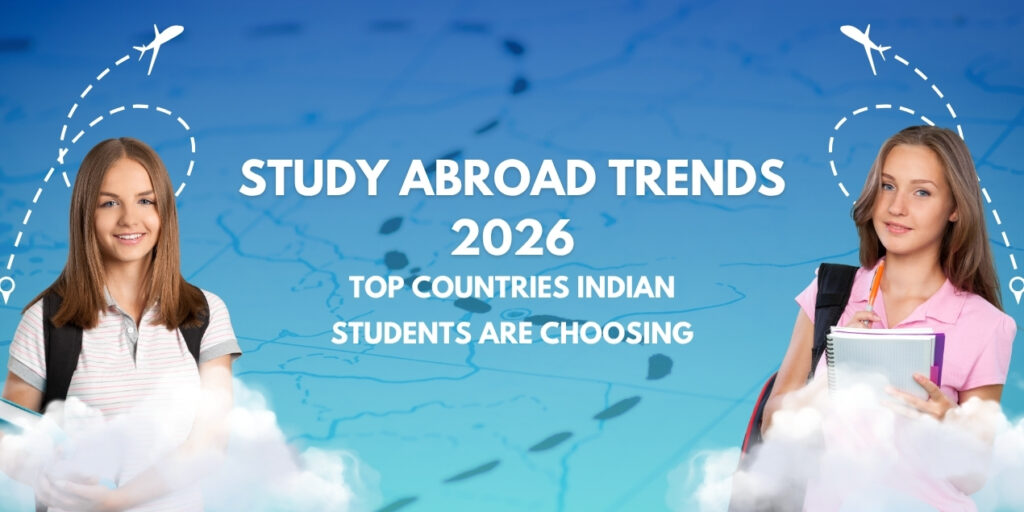
For nearly two decades, the study abroad journey for Indian students followed a predictable script: apply to the US, UK, Canada, or Australia, take the IELTS, get a visa, and go. In 2026, that script was rewritten. Rising tuition costs, tighter visa policies in traditional destinations, and a new generation of financially cautious families have pushed Indian students to look at the world map differently.
If you’re planning to study abroad in 2026 or helping a student make this decision, understanding these shifts isn’t optional — it’s the difference between a degree that pays for itself and one that leaves you buried in debt with no clear path forward. This guide breaks down exactly what’s changing, which countries are gaining ground, and how to make a decision based on data rather than hype.
Why the “Big Four” Are Losing Their Monopoly
The US, UK, Canada, and Australia built their reputations on strong universities, English-speaking environments, and clear post-study work pathways. Those advantages haven’t disappeared — but three things have changed the calculation for Indian families:
- Tighter immigration policy. Post-study work visa durations, dependent visa rules, and study permit caps have all seen adjustments in the last two years, making outcomes less predictable than they used to be.
- Currency-adjusted cost of living. Tuition in these countries has climbed faster than the rupee’s purchasing power, meaning the same degree now costs a noticeably larger share of a middle-class Indian family’s savings.
- Saturated job markets in specific fields. International graduates in fields like generic business management or IT services now face more competition for entry-level roles in these countries than they did five years ago.
None of this means the Big Four are bad choices — for the right student, in the right course, they remain excellent. But “because everyone goes there” is no longer a good enough reason.
Where Indian Students Are Actually Looking in 2026
Germany continues to be one of the fastest-growing destinations, largely because public universities charge little to no tuition even for international students, and the country has an acute shortage of engineers, IT professionals, and skilled tradespeople. The trade-off is the language requirement for many programs and a more bureaucratic visa process.
Switzerland appeals to a smaller, more specialized segment of students — particularly those pursuing hospitality management, finance, or engineering at globally ranked institutions. It’s expensive to live in, but salaries and post-study earning potential are correspondingly high.
France has expanded its English-taught master’s programs significantly and offers a relatively straightforward “Campus France” application process, plus a post-study job-search visa that’s genuinely usable.
Italy remains underrated. Several regions offer near-full tuition waivers and living stipends to students who qualify based on merit or family income — a detail most Indian students never even research.
The USA is still the top choice for students targeting STEM fields with OPT/STEM-OPT extensions, but application strategy now needs to account for more competitive visa interviews and a wider range of “safety” schools.
The UK remains attractive for its one-year master’s format, which saves a full year of tuition and living costs compared to a two-year US program — a factor that matters enormously when ROI is the primary decision driver.
Australia continues to draw large numbers of Indian students, particularly for postgraduate and vocational pathways, though recent policy tightening on student visa scrutiny means applications need to be far more thorough than before.
The Real Shift: From “Which Country Is Popular” to “Which Country Fits My ROI”
The single biggest change in how Indian students approach studying abroad in 2026 isn’t geographic — it’s psychological. Families are now asking three questions before anything else:
- What is the total cost, all-in, for this specific program?
- What is the realistic starting salary in that country for a graduate in this field?
- How long will it take to recover the investment?
This ROI-first mindset explains why countries like Germany and France — which weren’t traditionally “aspirational” destinations for Indian students — are now getting serious consideration. It also explains the growing interest in one-year master’s programs over two-year ones, and in STEM/technical fields over generalist business degrees.
Emerging Fields Driving Destination Choice
Course selection is increasingly dictating country selection, not the other way around. A few examples:
- Students targeting AI, data science, and machine learning are looking hard at Germany and the US, where research funding and industry partnerships are strongest.
- Healthcare and nursing aspirants are exploring the UK and Australia, both of which have structural workforce shortages in these fields.
- Hospitality and luxury management students continue to gravitate toward Switzerland, where the degree itself carries significant industry weight.
- Renewable energy and sustainability programs are pulling students toward European countries investing heavily in green infrastructure.
How to Actually Decide: A Practical Framework
Rather than chasing whatever destination is trending on social media, use this three-step filter:
Step 1 — Course first, country second. Search for the top 10–15 universities globally in your specific field, not just “best universities” lists. The country will usually reveal itself once you do this.
Step 2 — Run the real numbers. Add tuition, one year of living costs, visa/insurance fees, and flights. Compare that total against realistic starting salaries in that country and your home country if you return. Don’t rely on inflated “average salary” figures from consultancy brochures — check job portals in that country directly.
Step 3 — Check the post-study work runway. A degree is only as valuable as the time and pathway you’re given to convert it into work experience or residency. Confirm current post-study work visa rules directly on the government’s official immigration website before applying — these rules change often and consultancy websites aren’t always current.
A Word on IELTS and English Requirements
Regardless of which country you choose from this list, you’ll need strong English proficiency scores for almost all English-taught programs, and IELTS remains the most widely accepted test globally. Band requirements vary by country and course level, so it’s worth checking country-specific requirements early rather than assuming a single score works everywhere. Free AI-based IELTS practice tools have also made early-stage preparation far more accessible than it was even two years ago, letting students get a realistic band estimate before committing to expensive coaching.
Final Thought
Study abroad trends 2026 aren’t really about new countries becoming fashionable — they reflect a genuine maturing of how Indian families evaluate this decision. Cost, career outcomes, and post-study pathways now matter more than name recognition alone. Whichever country you choose, make sure it’s a decision built on research, not momentum.
Frequently Asked Questions:
There’s no single “best” country — it depends on your field of study, budget, and long-term career goals. Germany and France offer strong value for STEM and business fields with lower tuition costs, while the US and UK remain strong for research-intensive and one-year master’s programs respectively.
Yes, for the right student and course. These countries still have world-class universities and strong employer recognition. The key change is that students now need a more specific, well-researched plan rather than choosing these destinations by default.
Germany, France, and parts of Italy offer significantly lower tuition, especially at public universities, along with reasonable living costs compared to major UK or US cities.
Most English-taught programs across these countries require IELTS or an equivalent test, though exact band requirements vary by country and course. Some countries also accept alternatives like TOEFL or PTE Academic — always confirm with the specific university.
A one-year master’s, common in the UK and select European programs, typically saves one full year of tuition and living expenses compared to a two-year program, which can mean significant total savings depending on the country and course.
Calculate total program cost (tuition + living + visa/insurance) against realistic entry-level salaries in your target field in that country, and check the current post-study work visa duration directly on the official government immigration website.